Friday, February 11, 2011

Long Time

Celebrating my birthday with karaoke night and great friends 
Has it really been more than 2 months since I have written a blog post?  Wow time is flying!  At the end of November I went back to the States since my mother was having her foot reconstructed (after 6 weeks on crutches she is now happy to have one foot free of bunions and neuromas), celebrate my birthday, and Thanksgiving.  It was great to see family and friends and stock up on some of my favorite supplies (M+Ms, esp the mint ones, peppermint patties and black beans ;)
In Khami Ruins, near Bulawayo, Zimbabwe. 
One of the few remaining walls at Khami Ruins.  The royal family apparently lived on elevated rock walls on top of the hill (anything they could do to make themselves appear better than the common folk....)
The month of December flew by with a trip to Bulawayo, Zimbabwe over Christmas to see a beautiful national park, rock paintings, and ruins of an ancient civilization (Khami Ruins).  I celebrated New Year's Eve weekend in Cape Town which was a lot of fun as it is one of the most beautiful cities ever!
New Year's Eve in Cape Town! (thanks to Alexis for picking out the perfect shirt ;)
I feel like I wrote about these trips since all the pictures are on facebook, but I guess I never did.
I still cannot believe that January is over, it feels like the new year started yesterday.
I have also been doing some work ;)  I am still learning a lot from my patients.  Here are a few interesting stories.
B.C. is a 17 yr old who is doing really well on his HIV medications.  He always has good adherence, his virus is suppressed and he was a seemingly uncomplicated patient.  When I saw him at the end of December he said he had no issues, his physical exam was normal and his blood work looked good.  We talked about school (he is in Form 5, which is the last year here) and he said it was going okay, but that he wasn't doing as well as he wanted to be doing. He has been getting Bs (which is considered excellent here, esp at our clinic where most patients are getting Ds or Cs).  I told him about the tutoring program which we recently started to help kids with their school work since many of them are doing poorly and spend a lot of time at the clinic waiting for the doctors, medications, etc. He was excited and we agreed that he would meet the volunteers coordinating the program that day.  As I was printing out his note he said "you know I actually have been feeling kind of empty recently."  I turned around.  "What has been going on?" It then came out that he has been feeling depressed, has tried to commit suicide (he tried to drown himself in the bath tub) and is having a terrible relationship with his older brother who is his primary caregiver.  After several hours of discussion, involving our clinic psychologist, calling his aunt who came in (when I called her at work she dropped everything and came right away - she had sensed something was different, but did not know what to do and he had not told her anything), we worked out a safety plan.  He said he was feeling a bit better having told people and both he and his aunt felt that he could be safe at home.  He came back the following week and was feeling better having spent the Christmas holidays with his family in the north of Botswana.  He is now coming several times a week for tutoring, has brightened-up considerably, and has really formed bonds with the volunteer tutors.

I also got some sad news.  B.R. the very sick 10 month old whose house I went to back in Jan (see "Inreach" Jan 29) and who a few months later went missing has died.  We tried our best to track down the family last year, getting the local social worker and even the police involved, but we were unsuccessful.  This week our in-reach team was finally successful in contacting the mother's boyfriend who told them that the child had died.  We do not know what happened and still have not been able to contact the mother (according to her old boyfriend she does not have a cell phone) and get her care.  It is incredibly sad to know that B.R. most likely would have been fine had she been able to get her medications.  But unfortunately medications only work if you take them and sometimes there is no way to get that to happen.

Other times we are more successful.  P.S. is a 6 yr old who was admitted to the wards in January with severe pneumonia and Tuberculosis.  At an outside hospital they asked the family for permission to test for HIV and the parents declined.  However, since it was medically necessary to know, the hospital sent the test anyway and it came back positive.  The child was very sick so she was transferred to Gaborone.  When she arrived the team disclosed the positive diagnosis to the parents (it had not been disclosed at the outside hospital) and the parents were quite upset with the fact that the child had been tested despite their objections.  The reasoning was explained to them, but they refused to believe the diagnosis and refused to have her retested.  The ward team spent a lot of time with the family and the child recovered from her acute illness but they were still unable to convince them of the HIV positive status and need for treatment.  So they sent the family to our clinic for further counseling.
The nurse manager and I spent 2 hours trying to explain things to the parents, get them to consent to re-testing (so they could believe the diagnosis) and get them to test themselves.  The father (and culturally he spoke for the mother who refused to make any decisions without him) was adamant that no tests be done and wanted to have the opportunity to take the child to a church in South Africa to pray for her.  He is a primary school teacher and did have a basic understanding of HIV and said that he did not believe that praying could cure HIV, but he wanted the opportunity to pray for his sick child.  After much discussion and talking with the wards team it was agreed that the family would take the child to South Africa for the weekend and then return to the wards to have further discussion.  When the family did not return to the clinic as expected the following Monday we called the father who said he was still not ready to have the child tested.  However, he eventually did bring the child back to the wards that night.  Further discussion reveled that he thought that I (and the rest of the doctors) were on a mission to prove that his child was positive for research purposes (though we had never mentioned research of any kind).  So our social worker (whom he had not met and did not associate with the clinic) spent 5 hours with the family trying to come up with a solution.  At that time we had gotten the child's CD4 count back and it was 20 (showing that she was incredibly immune suppressed and needed to start treatment ASAP).  As this issue was quite urgent, they told the father that they might have to involve the police and what little child protective services there are here if he did not agree that the child needed treatment.  At that point the father took the child and the mother and stormed out of the hospital.  We were all worried that we had lost them and were planning to contact the police to try to find them.  However 24 hours later, the family returned.  The father had taken them all to a local testing center and they had all been tested and came back positive.  He brought the results to the hospital ward and apologized to the ward team for not believing them.  The next day we started the child on medications and the parents will go to have their CD4 count check to see if they need to start as well.  It has only been a week, but so far it seems that the family is giving the medications well and we remain hopefully that things will continue to go well.

So things are not always what they seem.  Sometimes the "stable" patients are actually the ones who need the most help and the ones who you think will never see the light eventually come around.  Of course, there are also the times, as in the case of B.R., when despite all of our best efforts we cannot reach an acceptable arrangement.  And I have also re-learned that sometimes patients just need time to come around and feel in control of the situation.  And of course gained even more appreciation for the importance of a team approach.

Monday, November 15, 2010

Soweto Marathon


Botswana group plus Duncan on far left (Baylor PAC doc in Swaziland)


.  Duncan, Bri, Premal, Matt, me, Amit, Gelane, Philip
 November 7th was the Soweto Marathon. There was no way I was even thinking about running a marathon, but who would give up the chance to do a 10 km walk through one of the most famous and culturally important neighborhoods in the world?
 We drove down to Joburg on Friday after work, arriving later than we had hoped. We were staying at a bed and breakfast in Soweto. Unfortunately there are two streets with the same name in Soweto, only one of the streets housed our B+B the other was in a rather dodgy part of Soweto and was the one the GPS chose to take us to, oops. Luckily the people who owned the bed and breakfast were extremely helpful and sent their son out to meet us and show us the way. Gotta love small family owned operations. The B+B was great. There were only 4 rooms and each had a lot of character
Here we are in front of the B+B
 On Saturday we spent the day exploring Soweto.  We started with a game of football with some of the children in the neighborhood.
 
Then we walked down Vilakazi Street (where Nelson Mandela, Desmond Tutu and other famous people lived). We made our way to the Hector Peterson Museum.  Hector Peterson was a 13 yr old boy who was killed by police on July 16, 1976 during a youth march protesting the use of Afrikaans as the medium of instruction in South African schools.  The museum was a tribute to him and all the others who died in the struggle.  It was well done with lots of photos, descriptions of the events, and videos.  Amazing to imagine 13 yr olds fighting and dying for a cause when many of today's 13 years can think of nothing but TV and play station.    
The fountain outside the museum (no photography allowed inside).  The picture is of one of the older youth carrying Hector with his sister walking alongside screaming.   
  After lunch on Vilakazi Street we headed to the University of Joburg where there was a Barista Competition.  Baristas (coffee makers) from all over the city were competing to see who was the best one.  I never knew there was so much technique involved.  Each barista had to make 4 espressos, 4 cappuccinos and 4 of a speciality drink, which they invented, in 15 mins while judges watched their every move.  They were even judged on whether the coffee that was pressed into the machine was completely level...It was kind of crazy but we got to drink some really good cappuccinos (unfortunately the drinks made by the baristas in the actual competition were only for the judges). 
 We had dinner at Wandie's Place (a famous restaurant in Soweto).  Not my favorite food as it was traditional South African buffet, but there was really not much for vegetarians (though the butternut squash was really good ;)  Went to bed early since we had to be up at 5 am for the race which started at 6:30 am!  The race left from soccer stadium (one of the new stadiums built for the World Cup) and the route was through Soweto which involved some rather large hills!  There were over 11,000 people participating (about 5,000 in the marathon and the rest either walking or running the 10 km).
Walking to the start did not count as part of the 10 km ;)
The walk started 10 min after the run so we got to see the winners of the 10 km run coming back.  Here they were passing the 8 km mark after only 20 min!  And many (as you can see here) were running barefoot!!!
Here we are going up one of the longest hills. It was seriously 1.5 km of straight uphill!
Around the 9 km mark and still going strong!
We finished in 1 hr on 35 min (I know it says 1:45 but the walk started 10 min after the run and the timer was for all of the 10 km ;)
The winner of the marathon finished in 2 hrs and 20 min!!!!  He ran 42 KM (26 miles) in 2 hours and 20 min and ran across the finish line like he had just gone for a little jog!  He was from Lesotho where there are also a lot of hills!
After the race, in our matching race shirts, trying to capture a jump shot

IN case you want to see more photos here is a slideshow of many more....


Thursday, October 28, 2010

New Diagnosis

Most days in clinic I see patients who are on anti-retroviral medications (ARVs) and are doing excellently. Today for some reason was different. Amidst the routine check-ups and failing teenagers I saw three children who were newly diagnosed. Luckily the number of newly diagnosed children is decreasing all the time in Botswana, so I can often go for a whole week without seeing one. Anyway I thought I would share their stories (I've changed their names).

Mpho is a 12 yr old boy who looked to be about 8. He came to clinic with his older sister. He has been sick on and off for many years now, but never sick enough to get admitted to the hospital. Recently he has had persistent diarrhea (often a sign of HIV infection and something that qualifies him to start on ARVs without even waiting for his CD4 count). His mother has also recently become sick and so his older sisters decided that both he and his mother should be tested. They both tested positive last week. His mother will get started on medications at the local clinic near where they live, but his sister wanted him to be seen at the children's center, so she brought him in. He was quite shy and did not really know why he was there. When I began to tell him about the bad guy in his body that was attacking his soldiers he said he knew that they bad guy was HIV. I asked what he knew about HIV and he said "there is no cure." "That is true, but there are very powerful treatments and with those medications you can live a long and healthy life and be anything you want to be!" He smiled a bit. We sent his baseline blood work, started him on prophylaxis against opportunistic infections, and had long discussion about the importance of adherence and who will help him with his medications. He will return next week to start ARVs.

Nametso is a 7 yr old who came with her mother and her baby sister. She is severely wasted with almost no fat on her body. Her mother is on ARVs already, but for some reason no one ever thought to test Nametso until today. For the last few weeks she has been coughing (occasionally blood tinged), has had fever on and off, and has night sweats (all signs of likely TB infection). Today her mother brought her to be tested and our rapid tests confirmed our suspicions that she is in fact positive. Luckily her baby sister is negative (she was born while the mother was on treatment). Cases like hers really make you realize the importance of asking about all family members and if they know their status. I try always to ask about siblings, parents, etc of the patients I am seeing and we stress the importance of this in the trainings we do, but it it is easy to forget in the course of a busy clinic day. Before we can start her on ARVs, we need to figure out if she has TB. She had signs of pneumonia on examination and I would have liked to get a chest x-ray, but the machine at the hospital has been broken for the last 2 weeks. So I treated her for bacterial pneumonia and arranged for her to get a sputum induction tomorrow (since children are often unable to cough up mucus we have a procedure to help them do that). Unless she gets dramatically better on the standard antibiotics, we will likely empirically start her on TB treatment since it is a hard diagnosis to make in children. And then she too will be started on ARVs.

Then there was Precious. She is 8 months old and was born to an HIV positive mother who actually got the Prevention of Mother to Child Transmission package. However even with the current prevention measures in Botswana, there is still a 4% chance of transmission (<1% in developed countries where women are started on full ARV therapy, given C-sections, and formula feed their babies). She seems to be one of the unlucky 4%. She came today with severe oral thrush. The thrush is so bad that she has not been eating or drinking well and was moderately dehydrated. For the last 4 months she has not gained any weight. She looked severely wasted, dehydrated, and pale (likely also has anemia). One look at her and I knew she had to be admitted. She was tested for HIV back in March (as per the guidelines babies born to HIV positive mothers should be tested around 2 months of age), but the results were never returned. No one told her mother to bring her back for repeat testing (despite the fact that she has not gained weight in 4 months which is often a sign of HIV infection in children) and it wasn't until she got sick that she was brought for repeat testing. With babies we have to do PCR testing which takes at least 2 weeks to get results, but looking at the baby I am pretty sure she will be positive. I walked her over to the pediatric medical ward and discussed the case with the medical officer. He placed an IV, drew blood, and admitted her to begin to rehydrate and stabilize her. We will find out her status for sure in 2 weeks and she will be started on treatment then (assuming it is in fact positive).
Another interesting case of today was Thato. He is 15 and came to clinic with his mother. They were both diagnosed in 2004 and neither has been started on treatment yet. They are both clinically doing well (some patients are able to ward off HIV for a long time before becoming sick). We have been monitoring his CD4 count and it has been steadily dropping over the last year (a sign that he needs to start ARVs soon). However, he and his mother are not ready to start. His mother has found some molasses which is supposed to boost the immune system and they have both started to take that. They are both pretty knowledgeable about HIV and understand that molasses is not a cure for HIV and that the only treatment for HIV is ARVs. His father is actually already on ARVs and doing really well. However, they feel that before starting a life-long therapy all other options should be tried and she wants to see if the molasses will work to boost the immune system and prolong the period of time before which medications have to be started. When I pointed out that the CD4 count was dropping despite the molasses she told me that was because she had not been able to afford the molasses for all of the last year, but that over the last month they were consistently taking it. We agreed to repeat the CD4 in a few weeks and if it is less than 250 (the cutoff in Botswana, though the World Health Organization now recommends 350 and in developed countries it is recommended that patients start way sooner,) he will start ARVs and if it remains high we will continue to wait.

It was a rough day, but luckily they aren't all like this!

Friday, October 15, 2010

KITSO

Sunset over Serowe.  Somehow it is one of the most beautiful places to watch a sunset I have ever experienced


Kitso is the Setswana word for knowledge.  So it was chosen as the name for the HIV trainings that occur throughout Botswana.  Since 2001 these trainings have taken place around the country to train health care workers about HIV, the adult HIV trainings are conducted by the Botswana/Harvard Partnership and the Pediatric HIV trainings are done by Botswana/Baylor.  This past week was my first time as presenter for the Kitso and I got to do it in Serowe (my old stomping grounds).  One of the medical officers from Baylor, Margaret, and I traveled to Serowe on Sunday and Monday morning began the week long training.  We had 30 participants, one pediatrician from Bangladesh who has been in Botswana for 4 months, 3 medical officers from India, Zambia and Botswana, 2 Nurse prescribers, many nurses, a dietitian, a social worker, and a few pharmacists all of whom work at the main hospital or the surrounding local clinics.  Monday and Tuesday were long days of lecturing on everything from epidemiology to diagnosis and treatment.  We tried to make it as interactive as possible and after an initial period of shyness the participants began to contribute.

On Wednesday we traveled to the hospital to do the practical portion of the Kitso.  We split the group into 5 groups of 6 and they began to interview and examine patients.  Margaret and I bounced from room to room helping them along as needed.  Many of them were surprised to find 12 year old children who had no idea why they were taking their meds.  Prior to attending the kitso they had assumed that parents and caregivers were disclosing the reasoning behind the medications to the children.  But what they found confirmed what we had taught them - most caregivers are reluctant to disclose to children and do not know how to do it, leading to children being lied to about the reasons and often getting traumatically disclosed when they are older.

One 5 yr old needed her blood drawn for a lab test and one in the group was qualified to draw blood.  So I donned a pair of gloves and got the needed equipment setting out to draw blood as I have done numerous times in the last year (I have actually gotten much better at drawing blood and placing IVs since being here where there is no IV team or phlebotomy team who are comfortable with children as there was in residency).  The girl was not happy with me and was sitting on her mother's lap screaming, but I manged to get the blood from a vein in her arm.  As I took the needle out with my left hand and held pressure over the site with my right thumb I managed to somehow nick my right thumb with the needle.  The needle pierced the glove and there was a little drop of my blood forming under the glove.  My first needle stick injury.  I immediately expressed as much blood as possible from my thumb and washed my hands, but there is still a slight chance of transmission (0.03% chance of transmission after a needle stick if you do nothing).  So I have started on what is called Post Exposure Prophylaxis (PEP) (basically I am taking 3 HIV medications for the next 28 days to prevent transmission.)  With 3 drug PEP the risk of transmission after a needle stick is extremely low, so I am not too worried, but I am truly experiencing what it is like to be on ARVs.  Luckily I have not really had many side effects (many people experience pretty severe vomiting while on PEP but so far I have had nausea and a weird taste in my mouth but have been able to tolerate the medication overall.)  However the medications have to be taken 2 times per day with food and the same time each day.  So I will have to wake up early on the weekends, make sure never to miss a dose, eat dinner at around the same time each day, etc...All of the things that my patients have to deal with every day for the rest of their lives.  I am lucky that I only have to deal with it for a month, but it is really giving me a taste of what life is like for my patients and an even greater understanding of just how hard it is.

Back at Kitso training, the participants presented the cases of the patients they had seen and we discussed all they had learned.  One said, "It was actually a wonderful experience because now I see, wow I really have not been doing this right!"  Friday morning we gave them the post test and found that most had learned a lot compared to their pre-test scores.  90% of them scored greater than 80% and all but one passed.  I just hope that they will be able to put this knowledge to use, since many do not actually work in the ARV clinics and will not be able to use all that they have learned everyday.  But if those not working with it every day, at least learned the diagnostic principles and that every person who presents for any kind of health care in Botswana should be offered an HIV test, I will be happy.   
Plenty of reasons to be cheerful, since it is now spring time in Botswana.  Everything is in bloom, including this plant, which I planted in Serowe and then transplanted when I moved to Gabs and which continues to thrive!

Thursday, October 7, 2010

Mozambique

 Last week was Botswana's Independence day, so we had Thursday and Friday off of work.  Bri, Gelane and I decided to take the first three days of the week off as well and take a week long trip to Mozambique.  It was an incredible week.  We traveled to the Barra Peninsula, which is on the Southeast coast and spent the entire week in a beach house 100 meters from the ocean.  The region is known for great scuba diving, so we decided that it would be a great opportunity to learn to scuba dive.  In four days we went from not knowing how to put the gear on, to scuba diving 15 meters deep and swimming with sea turtles!  It was a crazy experience.  The first two times I tried, I freaked out and did exactly what you are not supposed to do - come back up to the surface.  But I had a great scuba instructor who held my hand and led me down again.  By the third try, I was having fun.  It feels really weird to breath through your mouth the entire time and to have this mask in our mouth and on your face that you cannot remove.  And the popping of the ears was a constant feeling for the rest of the week.
But eventually we got the hang of it and got to swim with sea turtles, manta rays, fish, etc.  Each day we would get up go scuba diving in the morning, have a relaxing late morning, eat lunch and often go diving again in the afternoon.  The placed we stayed was fairly isolated and since we did not have a car we spent a lot of time eating and hanging out at the bar next door.  We made some friends with German tourists, Welsh tourists, a South African Family and the bartenders, scuba instructors, etc.  Most days we had the beach to ourselves which was incredible.
On Saturday morning we went snorkeling with the whale sharks!  After a week of scuba diving it was hard to get used to not being able to dive down and we spent a lot of time drinking ocean water!  Snorkeling is quite a challenge in an ocean because each time a wave comes you get a ton of salty ocean water in your snorkel.  But it was quite cool to swim after giant whale sharks!
All in all, it was a great week and as usually pictures tell the story a lot better so here is a slideshow....
 

Thursday, September 23, 2010

Flying Outreach

Since Botswana is so spread out and the majority of the country lives on the Eastern border, there are many parts of the country which are extremely rural these areas have few doctors and usually no specialists.  So a local NGO has organized charter flights to some of the sites which are the farthest from Gaborone.  They fly the plane above which seats 8 (9 if some one sits on top of the area that can act as a toilet in extreme emergencies) plus the 2 pilots.  Each Tuesday it flies specialists from Gaborone to a different area of the country (repeating on a monthly basis to cover 4 areas with monthly visits).  There is always a Botswana/Baylor Pediatric HIV specialist and a doctor from the Botswana/U. Penn program who can help consult on more difficult medicine patients.  Depending on the site there are other specialists from the government hospital as well (including orthopedic surgeons, nutritionists, and even an ultrasound tech who brings a portable ultrasound machine).  Last Tuesday, we (A family doctor from Botswana/Upenn, a TB specialist from Botswana/UPenn, a diabetes nurse from the Gaborone govt hospital, and I) went to Ghanzi which is all the way on the Western boarder of Botswana.  Since the plane is small, it is more subject to the winds and since they were strong on Tuesday it took us almost 2 hours (rather than 1.5hr) to fly from Gaborone to Ghanzi.  The pilots are excellent though, so it was really a smooth flight.   We arrived at the Ghanzi "airport" which is really a collection of small trailers and buildings and there was no one in sight.    
The Passenger waiting room is never really used, so they have filled it with a small collection of artwork, more like a museum than an airport waiting room and aptly called the "passenger terminal shed."
After about 15 min a van from the hospital came to drive us the 10 mins from the airport to the hospital.  The hospital is situated on the outskirts of town (so that they could make it nice and big).  Which makes it hard for people from the town to get to it without transport (much like Serowe).  However, it does look nice.
There is really nothing right around the hospital just a lot of empty land
  We finally arrived at the hospital around 10:30 and I headed to the HIV clinic to begin seeing patients.  I worked with a nurse prescriber to see 10 HIV positive children many of whom were either failing treatment or had multiple medical problems. One 17 yr old girl had the worst case of oral warts I have seen.  Warts (caused by the virus HPV) are more common in immunocompromised patients, because they are unable to fight the virus and thus it spreads unabated.  She had warts covering both her upper and lower lips and her tongue.  Unfortunately there are not many treatment options available other that ARVs (antiretrovirals) to boost the immune system and enable it to fight the HPV.  However, you can imagine the distress that this would cause a teenager (she has been dealing with it for years) and since it takes a long time to improve, she keeps stopping her ARVs because she feels it is not getting better.  I spent a lot of time trying to convince her to stick with the treatment and hopefully she will stick it out this time.

We saw a 1yr 8 mth old baby who was still not walking, not talking and had just started to attempt to crawl (a skill normally obtained around 8 mths of age).  And a nine year old who could not hear well, had never really talked, and had never attended school.  These children are the hardest, because there are no services available for them out in Ghanzi.  There are only a few places in the country where hearing can be tested (critical in both these cases) and they are all 100s of kilometers away.  There is only one speech therapist in the country and she is in Gaborone.  And the only special education schools that I know of are in the two bigger cities (Gaborone and Francistown).  For the baby we were able to refer her to the physical therapist (luckily there is one in Ghanzi) and for both I tried to encourage their mothers to take them to the nearest place where their hearing can be tested.  The nurse also informed me that there are some times when the ENT doctors come on the flights and might be able to do hearing testing then, he was going to investigate and then let the mothers know when to come back.  But without special education and lots of therapy, and possibly hearing aids, these children will never reach their full potential, and even if they were in Gaborone these would be really hard to come by.    

Another complicating factor is that a fair number of the patients in Ghanzi are San (a tribe that lives in the Kalahari desert and many of whom were resettled into towns by the Botswana government when they made the Kalahari protected land, much like what happened to Native Americans in the US).  Therefore many do not speak Setswana (much less English), so communication between health care workers and patients is especially difficult.  Also they have a lot of traditional medicine practices and it has sometimes been a challenge to get them to take ARVs.  Only one of the patients whom we saw on Tuesday was San and her mother spoke very good Setswana and was committed to the treatment, so it was not really an issue this visit.

After seeing all the children in the HIV clinic, I went to the pediatric inpatient wards to see if they had any cases they needed reviewed.  The medical officer was not around, but the nurses asked me to see a 3 yr old severely malnourished child who was not walking or talking.  There is a strong possibility that the child has HIV and I recommended an HIV test (something that really should be routine on every inpatient admission in this country, but seems to be missed a lot of the time despite our nagging).  If the child is positive, ARVs will likely help.  Otherwise we will be stuck with many of the same issues faced by the other developmentally delayed children, lack of appropriate special services.  It is frustrating to feel unable to provide any real solutions. 

We headed back to the Ghanzi airport at 5 pm (eating a lunch of crackers, granola bars, and oranges in the car) for our almost 2 hour flight home, feeling that we had done some education and treatment, but still there was so much left untouched.

Monday, September 20, 2010

Fun Times in Gaborone

Over the last few weeks we have had many opportunities to have fun in Gabs (as Gaborone is affectionately called).  We discovered that karaoke is offered every Thursday night at a local bar.  The bar, called The Tavern, has an scandalous reputation late at night and on the weekends, but we have had only the best of times there on Thursday nights singing up a storm of 80s and 90s tunes!
So when we decided to throw a big birthday party for 4 different people's birthdays, we hired the karaoke guys to come to our house.  Once they got over their shock that we did not own a TV (they brought their own), they agreed to come for 2 hours of awesome entertainment.  Everyone had a great time and then the party turned into a dance party lasting until 3 am.
Shikata, Becca, Jay and Bri (the birthday people) and their cake. They just so happened to sit in the right order too ;)
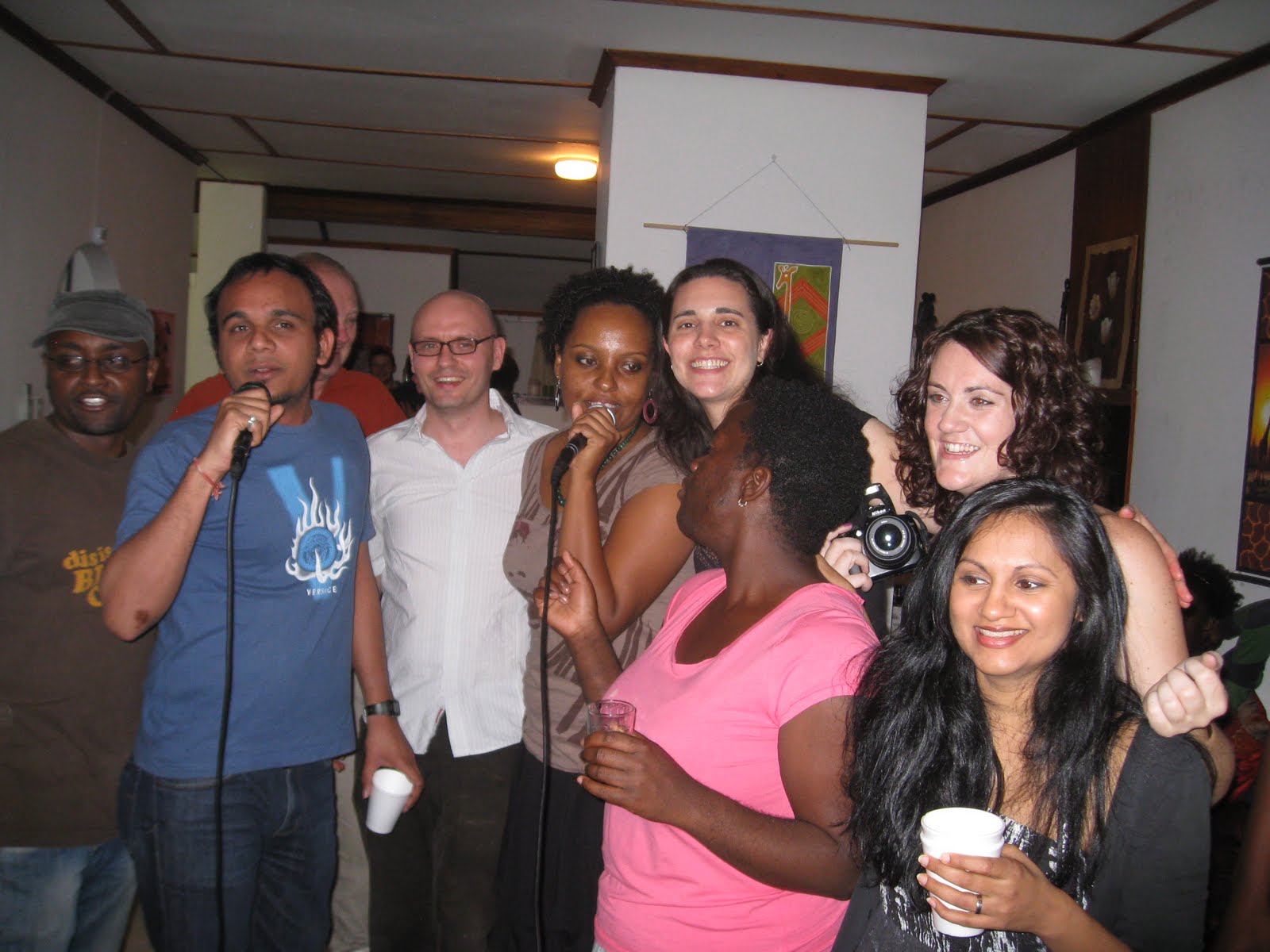
Group Karaoke, we didn't let the fact that there were only 2 mikes stop us from singing along!
This past Friday, Ringo Madlingozi was in town for a concert at Botswanacraft.  He is a big star in South Africa and came to preform in Botswana for the first time.  It was a sold out concert (which in Botswana means 1,000 people).  It was also the night before Yom Kippur so for me was an interesting substitute for Kol Nidre.  The night began with the Botswana Jazz Quintet, which includes our friend Matt Dasco on the sax!  After only 2 months here, he was already in the music scene and now, after a year in Bots, he is playing with the top guys! 
Matt on the Sax
Then Eugene Jackson (a local Motswana star) and his band played.
Eugene Jackson


Then Ringo and his band took the stage.  He sings in Zulu, so I had no idea what he was saying but it didn't matter.  The crowd was so into it, singing every word, and it just felt so great to be there listening to his beautiful voice.
It felt like a very personal concert, because there are no assigned seats and the venue is very small by US standards.  So we stood and dance right in front of the stage all night.
Gelane, Premal, me, Bri and Parth during the break between artists
The rest of the weekend was spent fasting, relaxing, reading, swimming, and watching Gizmo climb trees.
For those who don't know, Gelane and her cat Gizmo, (a cat who she rescued when he was a tiny baby kitten starving in front of our clinic and because he is all black he is considered bad luck here so no one wanted him), moved in to my house in the end of June.  And though I have never been a cat person, I have grown fond of Gizmo (when he is not trying to attack my foot - for some reason he has a foot fetish).  He is a crazy cat, climbing trees and up on the roof, trying to attack cats who are bigger than him and stalking all sorts of things (though luckily, so far, he has only managed to capture bugs).  Despite his craziness, he is very cute and can often be found curled up in my lap (as he is right now) trying to redeem himself for all the times he has tried to attack our feet or jumped up on the kitchen counter during the day.
Happy Jewish New Year to all those who celebrate it, and may this year bring joy and redemption to us all!