Saturday, November 7, 2009

Madikwe


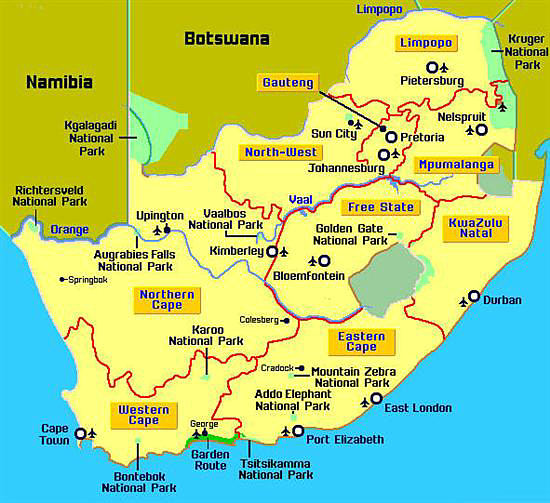
My mom found a way to come to South Africa for business - helping the Bafokeng (an ethnic group in South Africa) develop a better education system.  Luckily she had weekends off and we managed to spend them together.  The first weekend, I made my way to South Africa and we spent a wonderful 24 hours in Madikwe Game Reserve.  The reserve is along the Botswana/South Africa border and (according to their website) home to 66 mammal species and 300 bird species.  We had an incredible time.  We spent the night in Mosetlha Bush Camp.  It was a camp of nine tent cabins, with open sides and canvas tops.  There was no electricity or running water, but they had a very ingenious toilet and shower system.  You poured water from a tank into a "donkey boiler" and it came out the other end boiling hot.  You then mixed the water in your bucket until it was the desired temperature before carrying it to the pulley shower.  It was an amazingly refreshing shower!

But the best part of the weekend was certainly the animals!  We went on two 4 hour long game drives.  One from 4-8pm and the other 5:30-9:30 am!  We saw tons of animals.  Here are just a few highlights, for many more pictures and a few videos you can visit:
http://picasaweb.google.com/leah.scherzer/MadikweOct09?authkey=Gv1sRgCMXV2oDAi4GOEg#

Watching the giraffe get down low enough to drink was incredible

Dung Beetles!  
The female lays eggs in the ball of dung and then the male has to push the ball while female rides on it.

Four lions who were part of a pride of 16 who were just resting in the shade during the heat of the day

Mother and her baby elephant (probably less than a year old)

Monday, November 2, 2009

The Best and Worst


I cannot believe that it has been a month since I have written!  It has been quite a busy month and with the slow internet connection in Serowe I just have not gotten a chance.  But now that the Boards (aka worst test ever) are finished, (or at least I hope they are, since I really feel that I failed and we don't find out til January - not sure why scan tron takes so long), I should have more time. 

The weekend before we all left to take the boards a few of us decided that we had had enough studying.  So we headed to Tuli Block.  It is a strip on the very Eastern part of Botswana that is known for its elephants, among other animals.  It is about 2 hours from Serowe.  My friends were coming up from Gaborone and I did not want to take a third car so I decided to meet them in Palapye (the town 40 km from Serowe on the main road).  I was planning to take the bus, but when I discovered that it would require a taxi ride in the wrong direction to the bus station and waiting until the bus was full to leave (very unreliable when you have to be somewhere at a certain time), I decided to hitchhike.  Hitchhiking is a very common method of transport in Botswana.  However, as I stepped out of my house and felt rain drops I began to question my plan.  But I opened up my umbrella and walked the 1 min to the tar road near my house.  Just as I approched the road, a lady, who was also hitchhiking, was getting into a car.  I asked if they had room for me as well.  They made some minor adjustments and I climbed into the back seat with 2 other female hitchhikers and was on my way!  It turns out that picking up hitchhikers is a way to make extra money as they charge the same price as the bus (8 pula, slightly over a dollar - not bad for a 30 min drive).

After meeting my friends and driving 2 hours to Tuli Block we found Oasis Lodge where we had booked rooms and a "sunset safari."  The place really was an oasis with lush gardens and a nice swimming pool.  If only it wasn't rainy and cold.  Our guide arrived for "the safari" in a beat up pick-up truck which had been outfitted with benches which were strapped down to the flat bed.  No sides and certainly no seat belts, good thing we would be going slowly.  We set off and drove for about 2 hours and saw only impala (common deer like creatures which are beautiful, but not very exciting since we had seen plenty in Gaborone and the Rhino Sanctuary.


The next morning we went on a two hour walking safari.  We saw plenty of dung (the dung above is from elephants), but no animals other than a giant tortoise which our guide decided to bring back to the lodge (guess he is not afraid of salmonella poisoning...)  All in all a fun weekend.  Despite the lack of wildlife, it was really relaxing and a much needed break from studying!

On the way home I was pulled over for speeding (first time ever in my life).  Radar guns are a relatively new thing in Botswana.  Police officers stand on the road with the radar gun and wave you over if they determine you are going to fast.  Speed limits can be very confusing because there is often a sign when the speed limit drops as you enter a town, but often not a sign to indicate that it has gone back up even though town has ended. So on the way out of a small town they were pulling over everyone that passed.  The officer instructed me to get out of the car and see how fast I was going.  He showed me the radar gun which I could not read and told me I was going 95 km/hr in an 80 km/hr zone.  He pointed to a police car parked under a tree about 50 feet away and told me to "go talk to the boss."  The man who had gotten pulled over in front of me was getting out of the passenger side of the police car and walking back to his car.  I went back to the car got my id and told my friend, Steph, what was going on.  When I got to the police car, I found one cop in the driver seat and another in the back seat.  They told me to get in.  Tentatively I got into the passenger side.  The cop in the driver seat was wearing a bomber jacket that was half zipped and reclining back in the seat, providing a good view of his chest hair.  He asked me how fast I was going and I told him that his partner on the road had told me 95 km/hr.
He said "that will be 800 pula."  I stared at him (that is the equivalent of 121 dollars)!
I said "but i don't have 800 pula."
"what do you do"
"I'm a doctor"
"where do you work"
"serowe"
"well that's okay then."
Guy in the back seat, "we just need your name and phone number."  So I gave him my name but spelled it wrong and my number but changed one of the digits.  While this transaction was occurring and (the police officer in the back was putting this info in a cell phone!), the guy in the front began to get personal.
"So are you married?" "no" (in retrospect what was I thinking, but then you are taught to be honest, especially with law enforcement officials in uniform!).
"Can I check you in Serowe?"
So I began to lie."Don't think my boyfriend will like that"
"Well I can take him"
"I don't want you to take him, I love him"
This banter went on for a few more exchanges before the guy in the back had verified that he had gotten my correct (though actually incorrect) name and phone number.  Then I said "So, are we done here?" and got out of the car.  I walked back to Steph and the waiting car feeling rather violated and vowing to always pay utmost attention to the speed limit signs even though they are often hard to find!

Two days later I drove back to Gabarone in order to prepare to leave for the States and the dreaded board exam.  When I was about 30 km from Gabs and going 120 km/hr (the speed limit ;) I, all of the sudden, found myself in the grassy section by the side of the road spinning!  I had a tire blow out.  Luckily it was my back tire and so I did not go into oncoming traffic.  And luckily the car is sturdy enough that it did not flip.  Better yet before the car had even fully stopped a truck with 4 guys in the cab had pulled over.  They ran down the embankment saying "Are you okay?  We saw this happen and we weren't sure you were going to make it. Let us help you."   Still shaken and not quite sure what had happened, I would have been in tears if it wasn't for the kindness of strangers.  Another car stopped and 2 other guys got out and before I knew it 6 guys were changing my tire for me.  Good thing because it took all 6 of them, since the jack was not able to lift the car high enough given the fact that it was on dirt.  During ths process many other people stopped to see if I was okay.  So when I finally drove off there were about 10 people standing and cheering.  I then drove 80 km/hr back to Gabs and as each person who had stopped passed me, they waved and honked. It was truely wonderful to feel so taken care of by strangers.  I now have all brand new tires, because the one that had the blow-out was a re-tread and who knows how old the other ones were even though they looked decent. 


Top; there was some minor damage to the frame but my pieces were recovered from the road and put back on by my friendly mechanic.  
Left: My "attempt" at a newly formed road ;)  
On right my new friends survey the damage!


After all that excitement I went back to NJ to take the boards :(  Despite the annoyance of the exam, it was nice to be able to spend time with family and friends (though it was very short lived.)
Lots more adventures to write about, so hopefully there will be some more blogs soon....

Wednesday, September 30, 2009

The Campaign


The HIV prevention campaign in Botswana is quite extensive.  Every place you go there are signs, billboards, etc about HIV. The signs are much more explicit than education campaigns I have seen in the States.  Here are just a few examples.  The one above is part of the "break the chain" campaign.  There are billboards all over the city, highways, etc that state "Who's in your sexual network?" Some also say "break the chain" others leave it up to the individual to make the connection.


This sign is in the Serowe town center, right next to the bar.
If you look closely, you will notice that the wall of the bar is covered in "lovers" ads (a condom company)
A condom dispenser outside one of the public bathrooms at a local restaurant.
Unfortunately they are usually empty.

Even the inside of the moving truck that moved my furniture to Serowe was coverred in HIV prevention ads. The one of the inside of the truck is hard to read but says "Think before you act. Be wise Condomise"
Truckers are one of the highest risk groups, so this seems like a good place for ads.

Ads like this one for the controversial circumcision campaign are all over the city on billboards and buses.

They are trying to push the idea of personal accountability


One of the local free testing centers in Serowe


Free condoms were sitting on the nightstand of the hotel where I stayed on my first outreach trip to Serowe.

All of these seem like good ideas.  The unfortunate part is these campaigns are not working too well.  Condom use is still at only around 60% (though I guess that is higher than it was at the beginning of the epidemic, it has not incresed in recent years) and the prevalence of HIV in Botswana has increased slightly in the last year (0.5%).  It has decreased since the beginning of the epidemic but recently has gone up.  Getting people to change their behaviors is probably the hardest task in public health, but at least they are trying.  And putting ads in peoples' faces does force them to think and talk about HIV at least a little more than before.

Today is Botswana Day/Independence Day, 43 years since Botswana became an independent nation (luckily the diamonds were discovered after independence ;)  So Happy Independence Botswana!

Saturday, September 26, 2009

AIDS Impact


The Gabarone Iinternational Confernce Center at 
The Grand Palm Hotel (where conference was held)
Quite a nice facility


There were even peacocks on the grounds of the hotel!

This past Thursday and Friday I was lucky enough to be able to attend the AIDS Impact Conference in Gaborone.  It was an international 4 day conference where doctors, psychologists, researchers, economists, etc presented their research on different aspects of HIV and AIDS.  Much of the conference focused on the social and economic impact of AIDS.  It was quite interesting. Though some was disturbing.  For example, there was a study done in Botswana to see which groups were more likely to have multiple concurrent sexual partners.  (Public education about reducing the number of sexual partners and "breaking the chain of HIV" is one of the major areas being targeted as a prevention strategy.)  The study found that both women and men who were more educated and richer were more likely to have multiple concurrent sexual partners (defined as more 2 different people in the last month) when compared to their less educated poorer counterparts.  This is a bit disheartening because one would think that those who are more educated about the risks might be more likely to avoid risky behaviors.
There was also a big discussion of the role of circumcision in prevention of HIV.  Three different studies done in Africa have shown that circumcised males are less likely  to contract HIV when compared to their uncircumcised counterparts.  So there is now a big campaign in Botswana to circumcise men.   The problem is that circumcision is not as effective as condoms and does not provide any reduction in risk of transmission to women.  Some men after getting circumcised have a false sense of security and believe that they have a "natural condom."  However, if circumcision provides some protection maybe it is better than nothing since condom usage is only around 60% (despite widespread campaigns - more on that in a later post).   I find it to be a very interesting debate and can see both sides of the argument.
I attended a motivational interviewing workshop which will be quite handy (I hope) in trying to get through to teenagers.  There was also much discussion on the economic aspects of the epidemic and how by focusing only on HIV we have neglected so many other things.  On presenter told the story of people in Tanzania who after testing negative for HIV were upset.  When asked why, they responded that they had no food and wished they were positive because HIV positive people were eligible for food baskets!  What have we done?  Unfortunately there was not as much about where to go from here as I would have liked, but on the whole a very enlightening two days.  And there is hope from Thailand, with the first vaccine to show any benefit.  Still a long way to go but progress!

Here are some random pictures of the last week.


  Me and Julia in garden at the Serowe Hotel


Hanging out with some new Serowe friends


Me, Lincoln (Peace Corps volunteer), Shamu (medical officer from Zimbabwe), Joanna and Danny (doctors from Cuba), Louisa (doctor from Sierra Leone who has had a private practice in Serowe for many years) and Daniel (science teacher from Zimbabwe who studied in Cuba and has been teaching in Botswana for many years).  Quite a diverse group!


This is a picture of a girl I met in the center of Serowe who came up to me and said that she wanted to be my friend.  She said that she wanted to live in my house, I told her that was not going to happen.  Then she begged me to take her picture and send it to my friends in the States. So here it is.  (She is wearing an interesting shirt - not quite sure of the full meaning)

L'Shana Tova (Happy New Year) to all Jews reading this (and anyone else who wants to celebrate the Jewish New Year).  I hope that this year brings much happiness, hope, wisdom, and change to all the corners of the earth!

Friday, September 18, 2009

Disparities

This past week has been quite busy.  I worked at 2 different hospitals and one local health clinic.  The disparities in the care available to patients in the village compared to what is available in Gabarone are striking (not to mention when you compare it to The States!).  Botswana actually has quite a good preventative care model in theory.  Every village has some sort of health facility.  The smallest villages have mobile health posts that are staffed once a week or so by a nurse who travels to the area and does his/her best to provide basic services.  Larger areas have health clinics that are mostly staffed by nurses but medical officers visit about once/week.  Then there are district hospitals that can provide basic hospitalizations and procedures like c-sections.  Finally there are larger "referral" hospitals.  The problem is staffing and transportation.  The clinics are staffed largely by nurses who try their best and refer when things get more complex, but there are no x-rays or lab tests available at the clinics and getting patients to go to the hospital for these services or to be seen by a doctor is hard.  Also when patients are very sick at the local clinics the transportation to the referral hospitals can take too long and many don't make it. 

Even at the district hospitals resources are very scarce.  When I was in Palapye (the town about 20 min from Serowe) last week I saw a 10 year old with asthma who was breathing 70 times/min and really struggling for every breath.  She was in the "paediatric (they use the British spelling here) ward" which consisted of 2 small rooms (about the size of a standard single patient room in the states) each with 4 patients (one of the patients was sleeping on a mattress on the floor and all of the patients' mothers were with them - it was quite crowded.  There was no oxygen in the room and there was no nebulizer machine to give her albuterol which she so despirately needed.  As the "Paediatric Specialist" they wanted my advice.  Well, I thought she needed albuterol, oxygen, steroids, IV fluids, maybe even intubation the way she was breathing, but what was available?  The nurses were actually great once I explained that she was incredibly sick, but could get better with the right medications.  They found an albuterol pump and even a spacer which had been used by another patient, but we cleaned it!  One of them went and got an oxygen tank (of course, then we had to look for a face mask or nasal cannula - there were none to be found).  After about an hour (during which the mother was giving the child 2 puffs of the inhaler every 15 mins) a nebulizer machine was found! We (atcually they) even figured out how to plug it into the wall socket without an adaptor (all the wall sockets here have 3 square plugs and all the appliances have 3 round ones or 2 long ones, so you always need an adaptor for everything.  Unless you stick a pen into the top square plug and jam the two long ones into the bottom holes - or something like that - I use adaptors (don't worry mom and dad ;)).  We did not have a face mask so we rigged up the albuterol, so that the mother could sit with it under the child's mouth.  Then I suggested giving her IV fluids and a dose of magnesium.  There is no way to drip fluids here, and magnesium is supposed to be a slow infusion over 15 min.  So we calculted the amount, mixed it in a syringe and one of the nurses pushed in 1 ml every min for 15 min.  I felt kind of like McIvor.  But several hours later the patient was already sounding better and the next day she was home!

Not every story is as cheery, of course.  In Palapye almost every child I saw in clinic on Wednesday had a detectable viral load.  Basically when you are on treatment for HIV your viral load should be undectable.  If it is detectable then usually you are not taking the medications or have developed resistance (most often from a previous episode of poor adherence).  These children are largely failing because they are not taking the medications and mostly it is because they have no social supports.  Many are orphans living with relatives or in homes for orphans and no one ensures that they take their medications every day.  In Gabarone we have a psychologist and a social worker to help patients and families through these issues.  In the smaller villages there is sometimes a social worker, but usually it is one or two people for the entire hospital and there is not much they can do to change the home situation for many of these children.  Also in the district hospitals it is harder to get labs tests done and returned.  Viral loads have to be sent out and resistance assays (tests to see which medications the patient has developed resistance to.  We use this only when they are failing second line therapy to try and figure out a salvage regimen for them as third line) are taken to Gabarone one day a week.  On Wednesday the CD4 machine was down so none of the labs were being drawn.  All of this means that many of the children I saw had been failing for months and we were still unable to select a regimen that might work for them. 

The local clinic was even harder.  Basically the clinics are a collection of trailers.  The Infectious Disease Clinic (aka the HIV clinic but no one wants to call it that) is usually the last trailer in the back of the clinic.  Yesterday the one computer at the clinic (which provides lab results) was not working, so it was hard to figure out how to manage the patients with no results.  There are no appointment times at any of these clinics so all the patients show up before 7:30 and try to be first.  They end up spending all day waiting to see the doctor, then they have to wait in line again for a nurse to draw blood if they need it (to be sent to the hospital) and finally they have to go to the hospital to wait again in the pharmacy line and get thier ARV (anti-retroviral) medications.  So a visit to the doctor is at least a one day affair - more if you wait until the next day to go and get your medications filled.  It is no wonder that adherence is an issue.  And despite all this the vast majority of people are incredibly adherent to their medications (studies have shown that people in Africa are more adherent than those in the States.  I think it may be because everyone here knows someone who died of AIDS and they know that taking the medications is the only way to survive.) 


These are some views of one of the local clinics.  On the left is the waiting room with the 2 consulting rooms on either side.  Picture this filled with 70+ people waiting to see the doctor!  On the right is a bad picture of the trailers that make up the clinic.  (I was trying to be inconspicuous)
I don't want this post to be a total downer so I thought I would end with a picture of the beautiful sunset that I can see from my house every night.  The stars are also incredible. 

And here's one of the horses that often hang out right in front of our gate.  On some days there are donkeys too.  I'm not sure who they belong to, but they seem to know thier way home at night. 

Saturday, September 12, 2009

PHOTOS

Sorry for the random organization here but I can't figure out how to get them in a better order right now and internet cafe closes at 11:30 on Saturdays.....
My house in Serowe
There are 5 others just like in a row, I have the first one.
3 bedrooms, a bathroom, kitchen and living room,
quite spacious for one person (but plenty of rooms for visitors, hint, hint)
Classic bird on rhino picture
They were so intent on eating their grass, they did not seem to notice us even though we were about 10 feet away!  A good thing since they can be dangerous if mad!

(Don't think this one needs a caption you all know what this is ;)
My living room
The kitchen.  On the wall by the circuit board is the electricity unit.  I have to go and buy a electricity for the month and then enter a code in the box, which then supplies electrcity for the alloted killowatt hours.
A sunset view of the village from the top of a hill near the town center. 
It actually goes on for quite a distance.
Goats (and cows) are everywhere here.  They are definitely free range!  Here are some walking across the main road in the town center.  Apparently they all belong to someone and they find their way back to their respective farms (I'm not sure how).

Friday, September 11, 2009

"The Village"

I have moved to the “village.”  Serowe is a village of about 70,000 (a town by most US standards, but here they call pretty much everything that is not one of the two cities a village).  As I mentioned previously, it was the home of the first ever president of Botswana and birthplace of the current president Ian Khama (the first president’s son).  As such, it is a village that is well looked after which is probably one of the reasons that the large “referral” hospital was built here.  You can see pictures and description of the hospital here.
I officially moved here last September 1st.  It has been an adjustment.  Gabarone is a large city with many restaurants, movie theaters, etc.  In Serowe there is not as much of a recreational life.  However, there are high quality supermarkets, plenty of furniture (I’m not sure who buys things there as furniture is pretty darn expensive) and clothing shops, gas stations, a few hotels with restaurants, and tons of bars.  However, the internet infrastructure is lagging behind, there are many more dirt roads, there are many fewer foreigners, many more bugs and other critters, and very few doctors.  I am trying to get internet set up in my house which has been a process.  Though I live right next to the post office which has internet, (they even have an internet cafe but it closes at 4 pm), the Botswana Telecommunications Company says that all the lines are full (whatever that means) so there is no room for me to have a landline or internet.  I am working on looking into cell phone based satellite internet options, but until then might be hard to get pictures on the blog (there are so many to upload but they will come with time ;)  Despite the frustrations it feels good to finally fully unpack and feel more settled. 
I am working at many different sites in the area.  The hospital which is very nice, was built a bit outside of the main village and in a country where most people do not have cars this presents a challenge for the patients.  Many of them are continuing to go to the smaller local health clinics for care as they are more convenient.  Up until now, our program has provided support for two days each month to the main hospital’s clinic but we have not been helping at the smaller local sites.  I will be trying to roll out the support.  However, this is a challenge as there are no maps, no street names, and the clinics operate on a skeleton crew (often there is only a doctor once a week).  With the help of some locals, I have located two of the clinics and though there was no doctor there when I found them last week; I now know which days doctors will be there.  In addition to Serowe, I will also be working in two surrounding villages (Palaype (about 30 min away) and Mahalapye(about 1.5 hr away).  Both of these villages have larger hospitals and surrounding clinics as well, so I will be trying to work out a schedule that can provide support to as many as possible. 

The good news is that without internet or much nightlife, I have had plenty of time to study for the Boards.  However, last Friday I did manage to meet up with Lincoln (a Peace Corps volunteer stationed in Serowe) and he gave me a great tour of the town and introduced me to the friends he has made in his year here.  Many of his friends are from Britain and South Africa, so I got the beginning lesson on how to watch cricket (which was playing on the TV at the hotel restaurant/bar where we hung out).  I’m afraid it will take many more lessons before I have any idea what is going on (as it is I was just starting to understand American football when I left the States).  I have also made friends with some of the Cuban doctors here so there is a possibility of Salsa lessons and improving my Spanish….

Last Saturday (after I studied in the morning), Julia and Raheel came up from Gabs and we went to the Khama Rhino Sanctuary (only about 30 min from my new house) for the afternoon.  It was incredible.  The Sanctuary was set up in 1989 after it was recognized that the Rhino population in Botswana was becoming extinct.  The first four rhinos arrived in 1993 and since then a few more have been relocated to the Sanctuary and many more have been born.  There are now 34 white rhinos and 3 black rhinos.  They roam in an area that is 4,300 hectares (10,625 acres) and some have been relocated to other national parks in Botswana as the land can only support about 40 or so.  It has been quite a successful project and the rhinos continue to reproduce.  At the Sanctuary one can drive around in his/her own car alone or with a guide or can go on a game drive.  We elected to get a guide but take our own car so we would be free to spend as much time as we desired.  Our guide “Mr. T.” was a wealth of knowledge and of course excellent at spotting the animals.  We saw 12 of the white rhinos including 2 babies, giraffes, a zebra, wildebeest, kudu, springboks, ostriches, warthogs, and many different species of birds.  The black rhinos did not feel like showing their faces but we got up close and personal with a few of the white rhinos.  It was a great day and I know I will be back to visit many times in the future!